Mold Removal in MacDonald Ranch, NV
MacDonald Ranch is one of Green Valley's 24 planned areas, on the rising ground south of Horizon Ridge Parkway between Green Valley Parkway and Eastern Avenue, built through the 1990s and early 2000s. It is mostly gated single-story and two-story stucco homes on slabs under concrete tile, on lots that step up the slope toward MacDonald Highlands, with the older Green Valley grid below and the newer hillside custom homes above.
Sloped lots put the house's low side against the grade. A monsoon storm that runs off the lot above yours finds the base of the stucco on the uphill wall, and a weep screed buried under a decorative planter lets that water into the bottom of the wall instead of out. The other MacDonald Ranch mold call is the ordinary one: a garage water heater on its second or third replacement.
Homeowners in MacDonald Ranch reach an independent local mold provider through this site's phone line. That provider meters the house and tells you what it needs. We only set up the call.
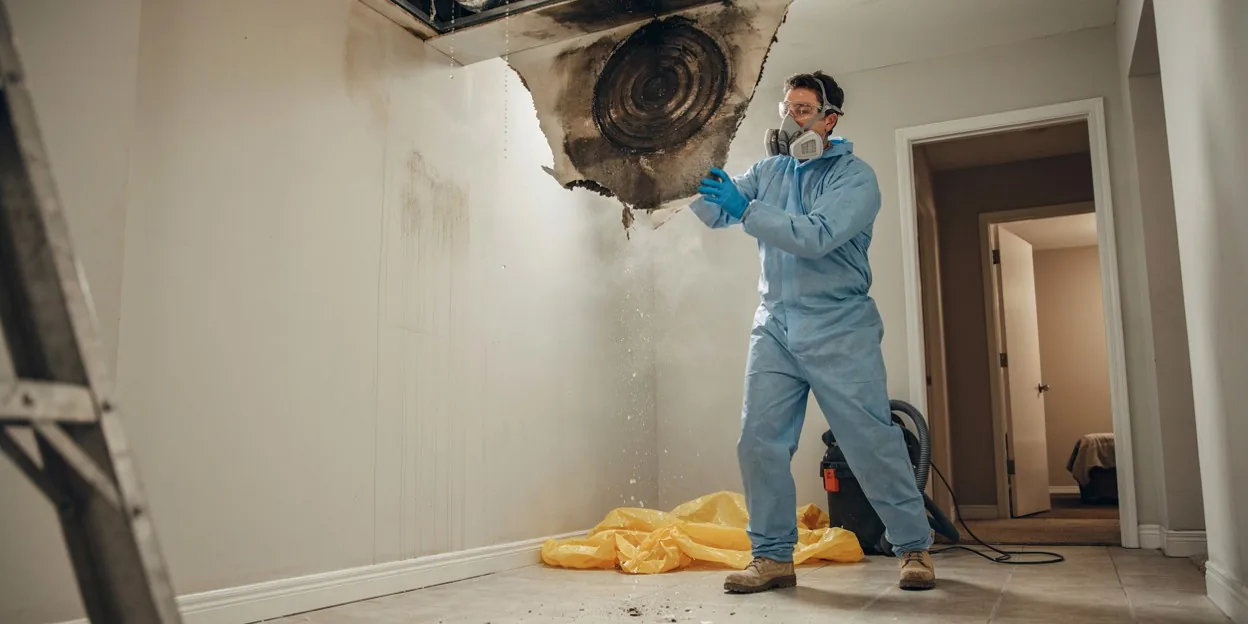
MacDonald Ranch mold removal on a stepped lot
Growth along the bottom of the uphill wall after a storm is mold removal, with the planter pulled back and the weep screed cleared before the wall is closed. A musty smell when the air handler starts is HVAC mold cleaning. The drywall and baseboard rebuild afterward is mold damage repair.
Where the grade runs, and who to ask about the gate
Most MacDonald Ranch streets are gated, so have the gate code or the guard's number ready for the crew, and check with your sub-association before an exterior stucco repair. The flood control district's channels take the big runoff; the planter against your uphill wall is the small runoff that no district maps.
Call (702) 602-8512 and tell us what you see. We put you through to a local mold provider serving MacDonald Ranch.
Services Available in MacDonald Ranch
Mold Removal
Growth on drywall behind a water heater, a fridge line, or a slab leak: room sealed, wet board cut to the meter line, framing HEPA-cleaned and dried.
Black Mold Removal
A dark patch handled by how far the water traveled, not its color: containment, porous material out, hard surfaces cleaned, leak fixed before closing.
Whole-Home Mold Remediation
A slab leak or a supply line that ran for weeks while the house sat empty, mapped room by room and cleared in zones as one project.
HVAC Mold Cleaning
Coil, drain pan, and condensate line cleaned or replaced when the air handler in the garage or attic sweats through a 110-degree summer.
Bathroom Mold Removal
Growth behind a vanity, under a shower pan, or on a ceiling with no fan, removed with the supply line or drain leak fixed first.
Attic Mold Remediation
Growth on roof sheathing under slipped tile or around a sweating duct, cleaned and treated once the underlayment or the insulation is fixed.
Mold Odor Removal
A musty smell in a house that looks fine, traced to the wet material under the laminate or behind the cabinet, then removed and treated.
Mold Damage Repair
Drywall, texture, baseboard, and cabinet bottoms put back after removal, once the slab reads dry and the leak that started it is repaired.